Providing proper chameleon UVB lighting is one of the most critical and often misunderstood aspects of chameleon husbandry. Unlike many reptiles that can survive with minimal UV exposure, chameleons require specific and carefully calibrated UVB lighting to synthesize vitamin D3, absorb calcium properly, and maintain overall health. This comprehensive guide will help you understand exactly what your chameleon needs and how to set up the perfect lighting system.
Why Chameleon UVB Lighting Is Non-Negotiable
In the wild, chameleons bask in natural sunlight that provides both heat and beneficial ultraviolet radiation. This UVB radiation triggers a photochemical reaction in the skin that produces vitamin D3, which is essential for calcium metabolism. Without adequate chameleon UVB lighting, even a calcium-rich diet cannot be properly utilized, leading to metabolic bone disease (MBD) – one of the most devastating and unfortunately common conditions in captive chameleons.
Metabolic bone disease in chameleons manifests as soft, pliable bones, curved limbs, a rubber-like jaw, difficulty climbing, and eventually paralysis or death. The tragedy is that MBD is entirely preventable with proper chameleon UVB lighting. No vitamin D3 supplement can fully replace the natural synthesis triggered by UVB exposure, making appropriate lighting absolutely essential rather than optional.
Understanding UVB Measurements for Chameleons
UV Index (UVI) Requirements
Chameleons require relatively high UVB exposure compared to many other reptile species. The appropriate UV Index varies by species:
Worried About Your Reptile's Health?
Upload a photo and get instant AI health analysis. Catch problems before they become expensive vet bills.
Get Free Health Check →- Veiled chameleons (Yemen chameleons) – UVI 3-6 in the basking zone
- Panther chameleons – UVI 3-5 in the basking zone
- Jackson’s chameleons – UVI 1-3 (lower, cooler requirements)
- Fischer’s chameleons – UVI 2-4 in the basking zone
These measurements should be taken at the actual basking spot where your chameleon will position itself. A UVI meter (solar meter) is an invaluable investment for any serious chameleon keeper, allowing you to measure actual UV output rather than guessing.
Choosing the Right Chameleon UVB Bulb
Linear Fluorescent Tubes (Recommended)
Linear T5 HO (High Output) fluorescent tubes are the gold standard for chameleon UVB lighting. These bulbs provide consistent, even UV distribution across a wider area than compact bulbs, which is particularly important for chameleons that move extensively throughout their enclosure. Recommended options include:
- Arcadia 6% or 12% T5 HO – Industry-leading bulbs with excellent UVB output and spectral quality
- Zoo Med Reptisun 5.0 or 10.0 T5 HO – Reliable and widely available options
- Exo Terra Repti-Glo 5.0 or 10.0 – Good alternative with solid performance
For most chameleon species in screen enclosures, the Arcadia 6% or Zoo Med 5.0 positioned 20-30cm from the basking area will provide appropriate UVI levels. The 12% or 10.0 bulbs may be necessary for larger enclosures or when mesh screening reduces UV penetration.
Mercury Vapor Bulbs (For Large Enclosures)
Mercury vapor bulbs (MVBs) combine heat and UVB output in a single bulb, making them useful for large, free-range setups. However, they require careful positioning to avoid overexposure, and their combined heat/UV output can be difficult to calibrate for smaller enclosures. If using an MVB for chameleon UVB lighting, ensure you can measure UVI at multiple distances to find the sweet spot.
Never Miss Early Warning Signs
AI photo analysis catches subtle health issues humans miss 80% of the time. Early detection = healthier reptile + lower vet bills.
Start Free Trial →Positioning Your Chameleon UVB Lighting
Proper positioning of chameleon UVB lighting is as crucial as bulb selection. Key considerations include:
Distance from Basking Spot
The distance between the UVB bulb and your chameleon significantly affects UV exposure. Screen enclosures reduce UVB penetration by 30-50% compared to open setups. As a general guideline for T5 HO bulbs through screen mesh:
- Arcadia 6%: Position 20-30cm from basking spot for UVI 2-4
- Zoo Med 5.0: Position 15-25cm from basking spot for UVI 2-4
- Arcadia 12%/Zoo Med 10.0: Position 30-45cm from basking spot for UVI 3-6
Creating a UV Gradient
Wild chameleons naturally regulate their UV exposure by moving to different positions throughout the day. Your chameleon UVB lighting setup should allow for this natural behavior by creating a UV gradient within the enclosure. Position the UVB bulb over one portion of the enclosure rather than covering the entire top, allowing your chameleon to move away from UV exposure when desired.
UVB Bulb Replacement Schedule
One of the most critical and overlooked aspects of chameleon UVB lighting is regular bulb replacement. UVB output degrades significantly over time, even when the bulb still appears to emit visible light. Chameleon keepers are often shocked to discover their “working” bulb is producing little to no UVB after several months of use.
Join thousands of successful reptile owners
Try ReptileCoach Free →Replacement guidelines for chameleon UVB bulbs:
- T5 HO linear tubes: Replace every 6 months for consistent output
- T8 linear tubes: Replace every 4-6 months
- Mercury vapor bulbs: Replace every 6 months or when output drops below acceptable levels
- Compact fluorescent bulbs: Replace every 3-4 months
Mark the installation date on your bulb with a marker or set calendar reminders to ensure timely replacement. Using a UVI meter to check output monthly allows you to track degradation and replace bulbs before they drop below effective levels.
Photoperiod: Timing Your Chameleon UVB Lighting
Chameleon UVB lighting should follow natural photoperiod patterns that mimic your chameleon’s native habitat. Most chameleon species do well with 10-12 hours of light during summer months and 10 hours during winter. Using a reliable timer ensures consistent light cycles, which is important for your chameleon’s circadian rhythm, feeding behavior, and reproductive cycles.
Avoid exposing chameleons to artificial light at night. Complete darkness during sleeping hours is essential for proper rest and hormonal regulation. Nighttime temperatures should drop naturally as the lights go off, mimicking the temperature gradient chameleons experience in the wild.
"This app saved my bearded dragon's life. The AI caught early MBD in photos I thought looked completely normal. Worth every penny!"
— Sarah K., ReptileCoach User
Get Your Free 7-Day Trial →Monitoring Your Chameleon’s Response to UVB Lighting
Observe your chameleon’s basking behavior regularly to assess whether your chameleon UVB lighting setup is meeting their needs. A chameleon that frequently basks directly under the UVB light with lateral flattening (broadside to the light) may need more UV exposure. Conversely, a chameleon that consistently avoids the basking area or shows stress colors may be experiencing too much heat or UV.
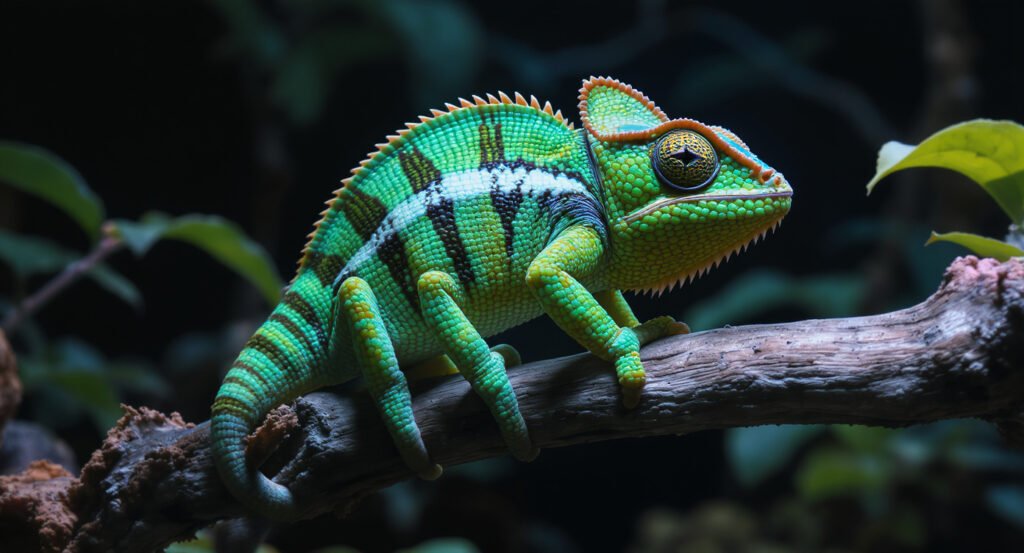
Healthy chameleons display strong grip strength, straight limbs, active hunting behavior, and vibrant coloration. Warning signs of inadequate UVB include lethargy, difficulty climbing, swollen joints, curved spine, tremors, or difficulty catching prey. If you notice any concerning symptoms, consult a reptile veterinarian immediately.
Take Your Chameleon Care to the Next Level
Managing all aspects of chameleon husbandry – from UVB lighting schedules to feeding routines and health monitoring – can feel overwhelming. That’s where technology can help. Check out the Reptile Coach app to track your chameleon’s lighting schedule, set replacement reminders for UVB bulbs, log health observations, and access expert care guides tailored to your specific chameleon species.
Conclusion
Proper chameleon UVB lighting isn’t just about buying any reptile bulb – it requires understanding your chameleon’s specific needs, choosing appropriate equipment, positioning bulbs correctly, and maintaining a consistent replacement schedule. By providing high-quality UVB exposure through linear fluorescent tubes, monitoring output levels, and creating an enclosure that allows natural UVB gradients, you’ll give your chameleon the foundation for a long, healthy life. Invest in quality chameleon UVB lighting from the start, and your chameleon will reward you with vibrant colors, active behavior, and years of fascinating companionship.
Worried About Your Reptile's Health?
Upload a photo and get instant AI health analysis. Catch problems before they become expensive vet bills.
Get Free Health Check →Ready to Give Your Reptile the Best Care?
Stop guessing and start knowing. Get personalized AI-powered care guidance, photo health analysis, and 24/7 expert advice for YOUR specific reptile.
Get Personalized Care Guidance
AI-powered photo analysis and daily care tracking for YOUR reptile
Try Free for 7 Days →