
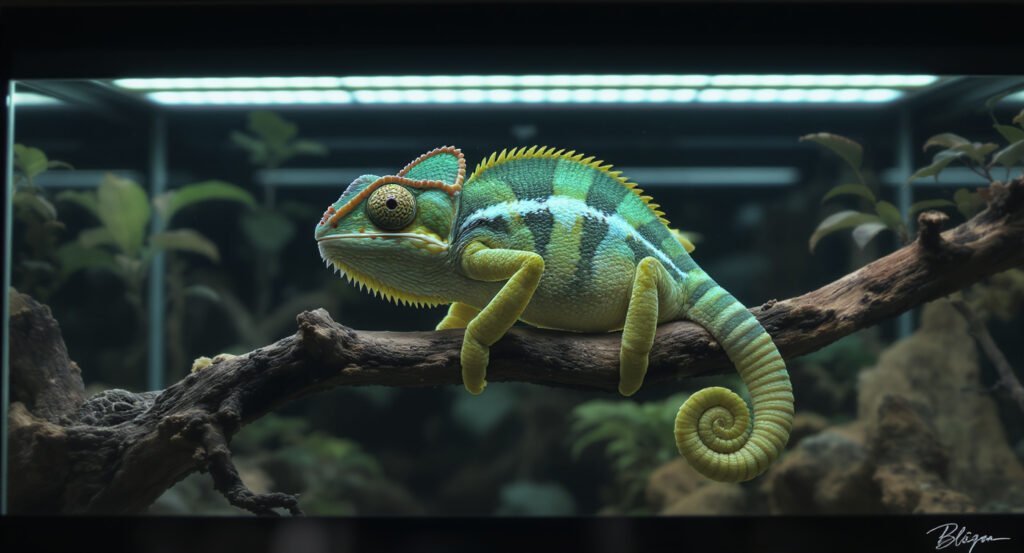
Proper UVB lighting is one of the most critical aspects of chameleon husbandry, yet it remains one of the most misunderstood. Without adequate UVB exposure, chameleons cannot synthesize vitamin D3, leading to metabolic bone disease and other serious health complications. This comprehensive guide will walk you through everything you need to know about chameleon UVB lighting requirements.
Why UVB Lighting is Essential for Chameleons
In their natural habitats across Africa, Madagascar, and parts of Asia and Europe, chameleons bask in natural sunlight that provides full-spectrum UVB radiation. This ultraviolet light triggers the production of vitamin D3 in their skin, which is necessary for calcium absorption and bone development.
Captive chameleons rely entirely on artificial UVB lighting to replicate this natural process. Without it, even chameleons receiving calcium supplementation cannot properly metabolize the mineral, resulting in weakened bones, neurological issues, and eventual death if left untreated.
Understanding UVB Output and Ratings
UVB bulbs are rated by their output percentage, which indicates the amount of UVB radiation they produce. For chameleons, you’ll typically encounter these options:
Worried About Your Reptile's Health?
Upload a photo and get instant AI health analysis. Catch problems before they become expensive vet bills.
Get Free Health Check →- 5.0 UVB bulbs: Suitable for some species in heavily planted enclosures with closer basking spots
- 10.0 UVB bulbs: Recommended for most chameleon species, providing stronger output
- 12% UVB bulbs: High-output options for larger enclosures or species requiring intense UVB
The percentage refers to the amount of total light output that falls within the UVB spectrum. Most chameleon keepers find success with 5.0 or 10.0 rated linear fluorescent tubes or their LED equivalents.
Types of UVB Lighting for Chameleons
Linear Fluorescent Tubes
Linear fluorescent T5 or T8 tubes remain the gold standard for chameleon UVB lighting. These bulbs provide consistent UVB output across their length, creating a larger basking zone. T5 bulbs are more efficient and produce stronger UVB at greater distances compared to T8 bulbs.
The recommended setup is a 24-inch or longer linear tube positioned across the top of the enclosure, ensuring your chameleon can move into and out of the UVB zone as needed.
Compact Fluorescent Bulbs
Compact or coil UVB bulbs are less ideal for chameleons because they provide a smaller zone of effective UVB coverage. However, they can work for smaller enclosures or juvenile chameleons when properly positioned. Their concentrated output pattern requires careful placement to avoid UVB overexposure or insufficient coverage.
Never Miss Early Warning Signs
AI photo analysis catches subtle health issues humans miss 80% of the time. Early detection = healthier reptile + lower vet bills.
Start Free Trial →Mercury Vapor Bulbs
Mercury vapor bulbs combine heat and UVB in a single unit. While convenient, they produce very high UVB levels and should only be used in large enclosures where the chameleon can regulate its exposure by moving closer or farther from the source. These are generally not recommended for most chameleon setups.
Proper Placement and Distance
The effectiveness of UVB lighting depends heavily on proper placement. UVB radiation diminishes rapidly with distance and is blocked by glass, plastic, and even screen mesh to some degree.
For T5 5.0 bulbs, position the basking branch 8-12 inches below the light. For T5 10.0 bulbs, maintain 12-18 inches of distance. These measurements should be adjusted based on whether the bulb is inside or outside the screen top—screen can reduce UVB output by 30-50%.
Always mount UVB bulbs above the enclosure where the chameleon can self-regulate exposure. Side-mounted lighting can work but requires careful monitoring to ensure adequate coverage of basking areas.
Join thousands of successful reptile owners
Try ReptileCoach Free →UVB Lighting Schedule and Duration
Chameleons require a photoperiod that mimics natural daylight cycles. Provide 10-12 hours of UVB lighting per day, using a timer to maintain consistency. This regular schedule helps regulate your chameleon’s circadian rhythm, appetite, and activity levels.
During winter months, you can reduce the photoperiod slightly to 10 hours, while summer months can extend to 12 hours. Avoid leaving UVB lights on 24/7, as chameleons need complete darkness for proper rest and hormone regulation.
Bulb Replacement and Maintenance
This is where many chameleon owners make critical mistakes. UVB bulbs lose their effectiveness long before they visibly burn out. Even though the bulb still produces visible light, UVB output degrades over time.
Replace fluorescent UVB bulbs every 6-12 months depending on the manufacturer’s recommendations. Some high-quality T5 bulbs maintain output for up to 12 months, while others should be replaced at 6 months. Keep replacement records to ensure your chameleon always has adequate UVB exposure.
"This app saved my bearded dragon's life. The AI caught early MBD in photos I thought looked completely normal. Worth every penny!"
— Sarah K., ReptileCoach User
Get Your Free 7-Day Trial →Clean your UVB bulbs and fixture monthly with a soft, dry cloth to remove dust buildup that can block UVB transmission.
Species-Specific UVB Requirements
Different chameleon species have varying UVB needs based on their natural habitats:
- Veiled Chameleons: Medium to high UVB (10.0 bulb at 12-15 inches)
- Panther Chameleons: Medium UVB (5.0 bulb at 8-10 inches or 10.0 at 15 inches)
- Jackson’s Chameleons: Medium UVB similar to Panthers
- Carpet Chameleons: Lower UVB (5.0 bulb in heavily planted enclosures)
Research your specific species’ natural habitat to better understand their UVB requirements. Forest-dwelling species may need less intense UVB than those from open, sunny environments.
Monitoring UVB Levels
Consider investing in a UVB meter (Solarmeter 6.5 or similar) to measure actual UVB output at basking level. This tool removes guesswork and helps you verify that your setup provides appropriate UVB levels, especially important when using screen tops or adjusting bulb distances.
Worried About Your Reptile's Health?
Upload a photo and get instant AI health analysis. Catch problems before they become expensive vet bills.
Get Free Health Check →Target UVB index readings of 3.0-6.0 at basking spots for most chameleon species, though some tolerate slightly higher or lower levels.
Track Your Chameleon’s Care with Technology
Managing UVB bulb replacement schedules, photoperiods, and species-specific requirements can be overwhelming. Track your chameleon’s lighting schedule with ReptileCoach, an app designed specifically for reptile keepers. Set reminders for bulb replacements, monitor lighting duration, and maintain comprehensive care logs to ensure your chameleon thrives.
Conclusion
Proper UVB lighting is non-negotiable for chameleon health. By selecting the appropriate bulb type and strength, positioning it correctly, maintaining a consistent photoperiod, and replacing bulbs on schedule, you create the foundation for a healthy, thriving chameleon. Combined with proper supplementation, hydration, and nutrition, quality UVB lighting helps your chameleon live a long, vibrant life in captivity.
Ready to Give Your Reptile the Best Care?
Stop guessing and start knowing. Get personalized AI-powered care guidance, photo health analysis, and 24/7 expert advice for YOUR specific reptile.
Get Personalized Care Guidance
AI-powered photo analysis and daily care tracking for YOUR reptile
Try Free for 7 Days →