“`html
Why UVB Lighting Is Critical for Chameleon Health
Chameleons require UVB exposure to synthesize vitamin D3, which enables calcium absorption and prevents metabolic bone disease. Without proper UVB lighting, your chameleon cannot process dietary calcium effectively, leading to bone deformities, tremors, lethargy, and potentially fatal health complications. Wild chameleons bask in natural sunlight throughout the day, and captive chameleons depend entirely on artificial UVB sources to replicate this essential environmental factor.
Metabolic bone disease remains one of the most common preventable conditions in captive chameleons, and inadequate UVB exposure is the primary cause. Understanding UVB lighting basics, selecting the right bulb type, and maintaining proper placement will give your chameleon the foundation for long-term health.
Understanding UVB Measurements and Requirements
UVB output is measured using the UV Index (UVI), which quantifies the intensity of ultraviolet radiation. For most chameleon species, you should provide a basking zone UVI between 3.0 and 6.0, with gradients down to lower levels in shaded areas. Veiled chameleons, panther chameleons, and Jackson’s chameleons all thrive within this range, though specific requirements vary slightly by species and natural habitat.
Worried About Your Reptile's Health?
Upload a photo and get instant AI health analysis. Catch problems before they become expensive vet bills.
Get Free Health Check →The Ferguson Zone system categorizes reptiles by their UVB needs. Most commonly kept chameleons fall into Ferguson Zone 3, requiring moderate UVB exposure with access to higher intensity basking spots. Montane species like Jackson’s chameleons may tolerate slightly lower UVI levels, while veiled chameleons from Yemen’s bright environments often appreciate the higher end of the spectrum.
Use a quality UVB meter such as the Solarmeter 6.5 to measure actual UVI levels at your chameleon’s basking branch. This device eliminates guesswork and ensures your setup delivers appropriate exposure regardless of bulb age or enclosure configuration.
T5 HO Linear Bulbs: The Gold Standard
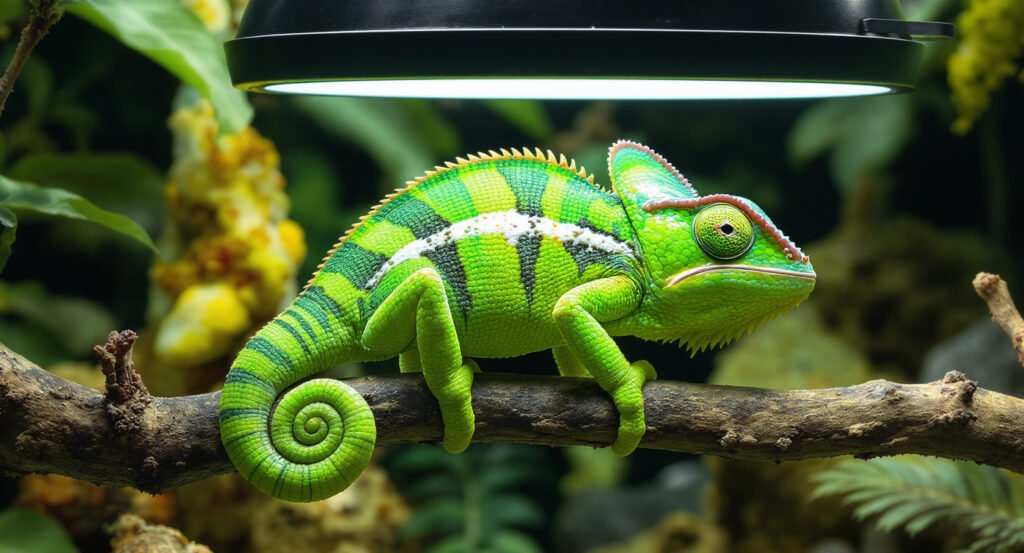
T5 High Output linear fluorescent bulbs provide the most reliable and effective UVB for chameleon enclosures. These bulbs deliver consistent UVB output across their length, creating natural gradients that allow chameleons to self-regulate exposure by moving closer or farther from the source.
The two most popular UVB strengths for chameleons are:
Never Miss Early Warning Signs
AI photo analysis catches subtle health issues humans miss 80% of the time. Early detection = healthier reptile + lower vet bills.
Start Free Trial →- 5.0 or 6% UVB bulbs: Suitable for screen-top enclosures with the fixture mounted directly on top, typically 8-12 inches from basking branches
- 10.0 or 12% UVB bulbs: Better for taller enclosures or when the bulb must be mounted farther from basking areas, or when used with glass or hybrid enclosures that filter some UVB
Always use a reflective fixture with T5 HO bulbs. The reflector doubles effective UVB output by directing light downward into the enclosure rather than scattering it in all directions. Fixtures without reflectors waste approximately half the available UVB and may fail to provide adequate exposure.
Position your T5 HO bulb so it spans most of the enclosure length, creating UVB availability throughout the upper regions while allowing shaded retreat areas below. Mount the fixture on top of a screen lid for most setups, ensuring proper distance between the bulb and basking branches.
Compact Coil Bulbs: When to Avoid Them
Compact fluorescent coil bulbs were once common but have largely fallen out of favor in the chameleon community. These bulbs concentrate UVB output in a small area, creating hotspots that increase the risk of eye damage or overexposure. They also degrade rapidly and provide inconsistent coverage across the enclosure.
If you must use a coil bulb temporarily, never position it closer than 12 inches from your chameleon, monitor for signs of eye irritation or excessive squinting, and upgrade to a linear T5 HO fixture as soon as possible. The investment in proper linear UVB lighting pays immediate dividends in chameleon health and reduces long-term veterinary costs.
Join thousands of successful reptile owners
Try ReptileCoach Free →Proper UVB Bulb Placement and Distance
Correct bulb placement determines whether your chameleon receives therapeutic UVB or insufficient exposure. Mount your T5 HO fixture on top of a screen enclosure lid, which filters approximately 30-40% of UVB while still allowing adequate penetration. Position primary basking branches 8-10 inches below the screen for most 5.0-6% bulbs, adjusting based on UVI meter readings.
Create a gradient by providing branches at multiple heights. Your chameleon should be able to bask directly under the UVB source when needed, then retreat to lower, shadier areas where UVI drops to 1.0-2.0. This choice is essential for natural thermoregulation and prevents overexposure.
Avoid placing glass or acrylic between the UVB bulb and your chameleon. Standard glass blocks up to 95% of UVB radiation, rendering even powerful bulbs ineffective. If using a hybrid enclosure with glass panels, ensure the top remains screen and the UVB fixture sits directly above open mesh.
UVB Photoperiod and Day-Night Cycles
Chameleons need 12 hours of UVB exposure daily to maintain proper vitamin D3 synthesis. Use a digital timer to automate your UVB bulb on a consistent schedule, turning it on in the morning and off in the evening. Match your UVB schedule to your basking light schedule, as chameleons naturally associate light intensity with the need to bask and absorb UVB.
"This app saved my bearded dragon's life. The AI caught early MBD in photos I thought looked completely normal. Worth every penny!"
— Sarah K., ReptileCoach User
Get Your Free 7-Day Trial →Never leave UVB bulbs on 24/7. Chameleons require complete darkness at night for proper sleep cycles and hormone regulation. Constant light exposure causes stress, suppresses immune function, and disrupts natural behaviors.
Bulb Replacement Schedule: When UVB Output Declines
Even though fluorescent bulbs continue producing visible light for years, their UVB output degrades significantly over time. Replace T5 HO bulbs every 12 months regardless of whether they still illuminate. Most bulbs lose 30-50% of UVB output by the one-year mark, even with minimal daily use.
Mark your calendar or set a reminder when installing a new bulb. Write the installation date directly on the bulb with a permanent marker, or track replacement schedules digitally. Regular replacement prevents the gradual decline that leads to subclinical vitamin D3 deficiency before obvious symptoms appear.
Recognizing Signs of UVB Deficiency
Early metabolic bone disease symptoms include:
Worried About Your Reptile's Health?
Upload a photo and get instant AI health analysis. Catch problems before they become expensive vet bills.
Get Free Health Check →- Lethargy and reduced appetite
- Weakened grip strength or difficulty climbing
- Tremors, especially in the limbs or jaw
- Curved or deformed bones, particularly visible in the spine and legs
- Swollen or kinked tail
- Rubber jaw or soft mandible that flexes under gentle pressure
If you notice any of these symptoms, consult a reptile veterinarian immediately and verify your UVB setup with a meter. Advanced metabolic bone disease causes permanent damage, but early intervention with proper UVB exposure, calcium supplementation, and veterinary care can halt progression.
Supplementation Works Alongside UVB, Not Instead of It
While vitamin D3 supplementation provides backup support, it cannot replace UVB lighting. Chameleons synthesize vitamin D3 naturally through UVB exposure in a self-regulating process that prevents toxicity. Oral D3 supplementation lacks this safety mechanism and risks overdose if used as the sole source.
Use calcium with D3 powder sparingly (1-2 times per week) while maintaining proper UVB lighting. The combination ensures your chameleon receives adequate calcium absorption support without relying solely on dietary supplementation.
Keep your chameleon on the right schedule — track UVB bulb age, feeding logs, and vet visits in one place with the free ReptileCoach app.
Never Miss Early Warning Signs
AI photo analysis catches subtle health issues humans miss 80% of the time. Early detection = healthier reptile + lower vet bills.
Start Free Trial →“`
Ready to Give Your Reptile the Best Care?
Stop guessing and start knowing. Get personalized AI-powered care guidance, photo health analysis, and 24/7 expert advice for YOUR specific reptile.
Get Personalized Care Guidance
AI-powered photo analysis and daily care tracking for YOUR reptile
Try Free for 7 Days →