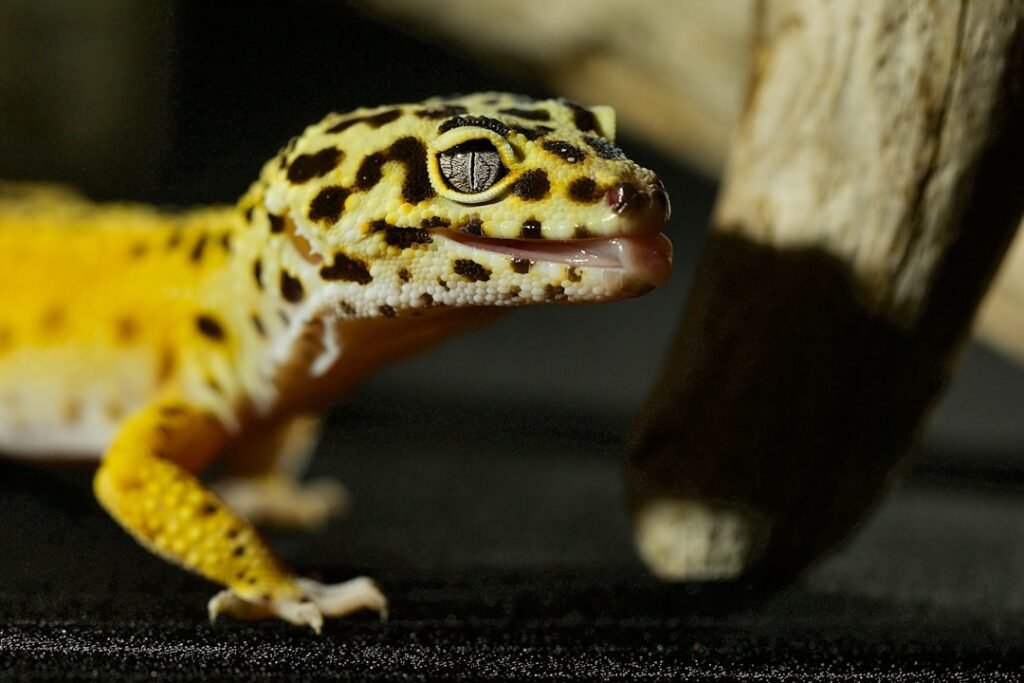
If you’ve ever set a UVB bulb on top of your leopard gecko’s mesh screen lid and wondered how much of that beneficial ultraviolet light is actually making it through to your little friend, you’re asking one of the most important and most overlooked questions in reptile husbandry. Screen tops are practically universal in leopard gecko setups, but they quietly filter out a surprising percentage of UVB radiation before it ever reaches your gecko’s basking spot. Understanding exactly how much UVB gets blocked, and how to compensate for it, can make a real difference in your gecko’s long-term bone health, vitamin D3 synthesis, and overall wellbeing.
Why UVB Matters for Leopard Geckos
For years, the common advice was that leopard geckos are crepuscular and don’t need UVB lighting at all. The thinking was simple: they’re active at dawn and dusk, they hide during the day, so just dust their feeders with calcium and D3 powder and call it good. But more recent research and keeper experience have shifted that perspective significantly.
Leopard geckos in the wild are exposed to low levels of UVB during twilight hours and even through shaded microhabitats during the day. Studies, including notable work by Dr. Frances Baines and the UV-Tool project, have shown that leopard geckos will voluntarily expose themselves to UVB in a gradient when given the option. This exposure allows them to synthesize vitamin D3 naturally through their skin, which is far more biologically regulated than relying solely on dietary supplementation.
Providing appropriate UVB helps prevent metabolic bone disease (MBD), supports immune function, improves appetite, and encourages more natural behavior. The key word here is appropriate, and that’s where your screen top enters the equation.
Worried About Your Reptile's Health?
Upload a photo and get instant AI health analysis. Catch problems before they become expensive vet bills.
Get Free Health Check →How Much UVB Do Screen Tops Actually Block?
This is the core question, and the answer depends on the type of mesh you’re using. Not all screen tops are created equal, and the material and weave density make a significant difference in how much UVB passes through.
- Standard aluminum mesh screens (the kind that come with most Exo Terra, Zoo Med, and similar tank lids) typically block 30% to 50% of UVB output. Most keepers can expect roughly a 35% to 40% reduction as a reasonable working estimate.
- Fine steel mesh screens with a tighter weave can block 50% to 70% of UVB, making them particularly problematic if you’re relying on a low-output bulb.
- Coarser or wider-gauge mesh blocks less, sometimes in the range of 20% to 30%, but these are less common in standard reptile enclosures.
The reason for this blocking effect is straightforward. UVB wavelengths (in the 280–315 nm range) travel in straight lines. Every wire in the mesh grid casts a tiny shadow and physically obstructs a portion of the light. The finer and more tightly woven the mesh, the more cumulative shadow and obstruction you get. It’s not that the mesh absorbs UVB in the way glass does. It simply blocks the line of sight between the bulb and your gecko.
The Calculation: Working Out Effective UVB at Basking Level
Let’s walk through a practical example so you can apply this to your own setup. You’ll need two pieces of information: the UVB output of your bulb at a given distance, and the estimated blocking percentage of your screen.
Step 1: Find your bulb’s UVB output. Manufacturers often list the UV Index (UVI) at specific distances. For example, a popular choice for leopard geckos is the Arcadia ShadeDweller ProT5 Kit, which produces roughly a UVI of 2.0 to 3.0 at about 25–30 cm (10–12 inches) from the bulb without any obstruction.
Never Miss Early Warning Signs
AI photo analysis catches subtle health issues humans miss 80% of the time. Early detection = healthier reptile + lower vet bills.
Start Free Trial →Step 2: Determine your screen’s blocking factor. If you’re using a standard aluminum mesh screen top, use 35% as your estimate. This means 65% of the UVB passes through.
Step 3: Multiply. If your bulb produces a UVI of 2.5 at 30 cm without a screen, the effective UVI through the screen is:
2.5 × 0.65 = 1.625 UVI
That’s the approximate UV Index reaching your gecko at that distance after the screen does its filtering.
Join thousands of successful reptile owners
Try ReptileCoach Free →Step 4: Factor in distance. UVB intensity drops off with distance following the inverse square law. If your gecko’s basking spot is further from the bulb than the manufacturer’s rated distance, the effective UVI drops even more. For every additional few inches, you can lose another meaningful chunk of output.
Here’s a quick reference table for a bulb rated at UVI 3.0 at 30 cm, passing through a standard aluminum mesh (35% blocked):
- At 25 cm from bulb: ~3.5 UVI raw → ~2.3 UVI through screen
- At 30 cm from bulb: ~3.0 UVI raw → ~1.95 UVI through screen
- At 40 cm from bulb: ~2.0 UVI raw → ~1.3 UVI through screen
- At 50 cm from bulb: ~1.2 UVI raw → ~0.78 UVI through screen
What UVI Range Should You Target for Leopard Geckos?
According to the Ferguson Zone classification system, leopard geckos fall into Ferguson Zone 2, which means they naturally seek out UV Index levels between 0.7 and 1.0 in their basking zone, with brief exposures up to around UVI 2.6 to 3.0 at the upper end.
This means you want the UVI at your gecko’s basking spot, after accounting for screen blocking and distance, to land somewhere in that sweet spot. A reading of 1.0 to 2.0 UVI at the basking surface is generally ideal. Your gecko should also have the ability to retreat to a shaded zone with zero or near-zero UVB so it can self-regulate its exposure.
"This app saved my bearded dragon's life. The AI caught early MBD in photos I thought looked completely normal. Worth every penny!"
— Sarah K., ReptileCoach User
Get Your Free 7-Day Trial →If your post-screen calculation shows a UVI below 0.7 at the basking spot, your gecko isn’t getting meaningful UVB benefit. If it’s consistently above 3.0, you risk overexposure, which can cause eye irritation and skin discomfort.
Practical Tips to Compensate for Screen Blocking
Now that you understand the math, here are some real-world strategies to make sure your gecko gets the right amount of UVB despite the screen top.
- Mount the bulb closer to the screen. Reducing the distance between the bulb and the mesh minimizes the total distance to your gecko’s basking spot, which helps offset the screen’s filtering effect.
- Use a bulb with slightly higher output. If a low-output bulb drops below useful levels after screen filtering, stepping up one tier in bulb strength can compensate. For example, moving from a 2% UVB compact to a ShadeDweller or similar T5 fixture designed for Ferguson Zone 2 species.
- Cut a small section of mesh and mount the bulb inside. Some keepers remove a portion of the screen directly under the UVB fixture and mount the bulb inside the enclosure using a guard or reflector. This eliminates the screen loss entirely but requires a protective cage around the bulb to prevent burns and direct contact.
- Invest in a Solarmeter 6.5R. This handheld UV Index meter is the gold standard for reptile keepers. It lets you measure the actual UVI at any point in the enclosure, taking all variables into account at once. It’s not cheap, typically around $200 to $250, but it removes all guesswork and is invaluable if you keep multiple reptiles.
- Replace bulbs on schedule. UVB bulbs degrade over time. Most T5 bulbs should be replaced every 12 months, and compact fluorescents every 6 to 9 months, even if they still produce visible light. The UVB output drops long before the bulb burns out visually.
- Angle matters. UVB output is strongest directly below the bulb and falls off toward the edges. Position the basking spot directly under the center of the bulb, not off to the side, to maximize what gets through the screen.
Common Mistakes to Avoid
Even well-intentioned keepers make a few recurring errors when it comes to UVB and screen tops. Here are the ones to watch for:
- Assuming the screen doesn’t matter. A 35% to 40% reduction is not trivial. If you set up your UVB based on the manufacturer’s unobstructed distance chart without accounting for the screen, your gecko could be getting significantly less UVB than you think.
- Stacking a screen and glass. Some enclosures have both a mesh screen and a glass or acrylic panel. Glass blocks virtually all UVB. If there’s any glass between the bulb and your gecko, the UVB reaching them is effectively zero, regardless of the bulb’s strength.
- Using the wrong type of UVB bulb. High-output desert bulbs (10.0 or 12% UVB) are designed for bearded dragons and desert species. For leopard geckos, a lower-output bulb in the 2% to 7% range, matched to Ferguson Zone 2, is far more appropriate. Too much UVB is a real risk for a shade-dwelling species.
- Forgetting the UV gradient. Your gecko needs the choice to move in and out of the UVB zone. The bulb should cover only one-third to one-half of the enclosure at most, leaving the rest as a UV-free retreat.
Bringing It All Together
Getting UVB right for your leopard gecko doesn’t require a physics degree, but it does require a little awareness of what’s happening between your bulb and your gecko’s back. Your screen top is filtering out roughly a third or more of the UVB your bulb produces, and that matters when you’re working with a species that only needs modest UV exposure to begin with. Run the simple calculation: take your bulb’s rated UVI at the relevant distance, multiply by 0.6 to 0.65 for a standard aluminum mesh, and check that the result falls within the 0.7 to 2.0 UVI range at the basking spot. Combine that with proper bulb choice, correct positioning, a UV gradient for self-regulation, and timely bulb replacement, and you’ll have a setup that supports your leopard gecko’s natural vitamin D3 production the way nature intended. A small investment in understanding the math behind your screen top pays off in a healthier, more active gecko for years to come.
Worried About Your Reptile's Health?
Upload a photo and get instant AI health analysis. Catch problems before they become expensive vet bills.
Get Free Health Check →Ready to Give Your Reptile the Best Care?
Stop guessing and start knowing. Get personalized AI-powered care guidance, photo health analysis, and 24/7 expert advice for YOUR specific reptile.
Get Personalized Care Guidance
AI-powered photo analysis and daily care tracking for YOUR reptile
Try Free for 7 Days →