“`html
Red-eared sliders are among the most popular pet turtles, but they require a substantial commitment to proper housing. A well-designed habitat is essential for your turtle’s health, longevity, and quality of life. This guide covers everything you need to create an optimal environment for your red-eared slider.
Tank Size: Bigger Is Always Better
The single most important investment you’ll make is the tank itself. Red-eared sliders grow larger than most people expect, with adults reaching 8-12 inches in shell length.
Minimum tank size for adult red-eared sliders is 75 gallons. Hatchlings can start in smaller tanks (20-40 gallons), but upgrading to a 75-gallon or larger tank within the first year or two is necessary. Many experienced keepers recommend starting with a 100-gallon tank or larger to avoid the expense and hassle of upgrading.
Worried About Your Reptile's Health?
Upload a photo and get instant AI health analysis. Catch problems before they become expensive vet bills.
Get Free Health Check →The general rule is 10 gallons of water per inch of shell length, but this is a bare minimum. Red-eared sliders are active swimmers and larger tanks provide better water quality stability, more swimming space, and easier maintenance.
Water Depth and Quality
Red-eared sliders are aquatic turtles that spend most of their time in water. Water depth should be at least 1.5 to 2 times the length of your turtle’s shell. For an adult turtle with a 10-inch shell, this means a minimum water depth of 15-20 inches.
Deeper water allows for more natural swimming behavior and helps maintain stable water parameters. However, ensure your turtle can easily reach the basking platform from the water.
Water Temperature
Maintain water temperature between 75-78°F using a submersible aquarium heater. Use a reliable aquarium thermometer to monitor temperature daily. Cold water can suppress appetite and immune function, making your turtle susceptible to respiratory infections and other health issues.
Never Miss Early Warning Signs
AI photo analysis catches subtle health issues humans miss 80% of the time. Early detection = healthier reptile + lower vet bills.
Start Free Trial →The Basking Platform: A Non-Negotiable Requirement
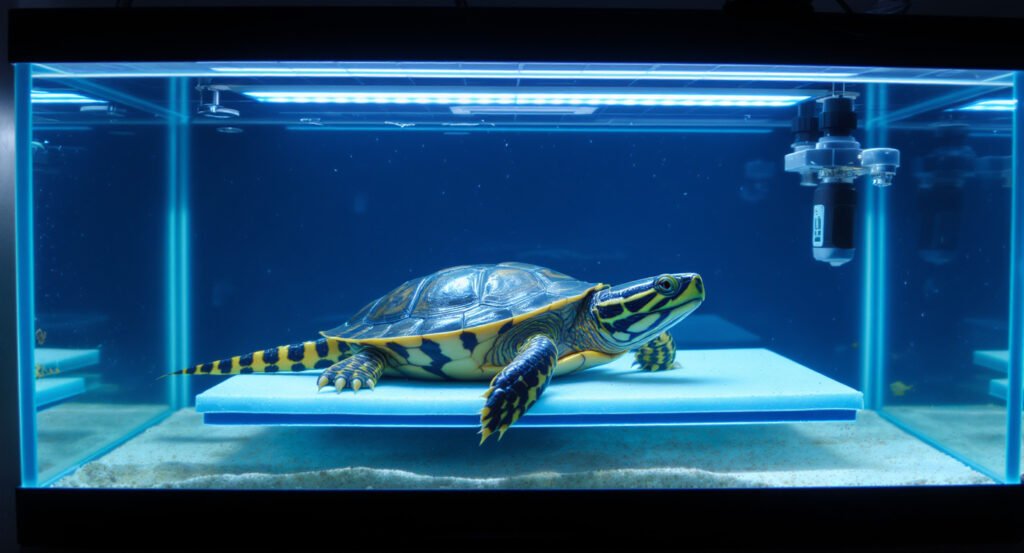
Red-eared sliders must have access to a completely dry basking area where they can thermoregulate and dry their shells. The basking platform should:
- Be large enough for your turtle to turn around comfortably
- Be easily accessible with a gradual ramp or textured surface
- Be positioned to allow at least 12 inches of space between the platform and the UVB light
- Be stable and secure to prevent tipping
- Have a completely dry surface (no water pooling)
Commercial turtle docks, floating platforms, or DIY solutions using slate, egg crate, or PVC can all work effectively. The key is ensuring your turtle can completely dry off to prevent shell rot and fungal infections.
Lighting: UVB and Heat Requirements
UVB Lighting
UVB light is critical for red-eared sliders to synthesize vitamin D3, which enables calcium absorption and prevents metabolic bone disease. Without proper UVB exposure, turtles develop soft shells, deformed growth, and potentially fatal health complications.
Requirements for UVB lighting:
Join thousands of successful reptile owners
Try ReptileCoach Free →- Use a 10% UVB reptile bulb designed for turtles
- Position the bulb 10-12 inches above the basking platform
- Run the light for 10-12 hours daily to simulate natural day/night cycles
- Replace UVB bulbs every 6-12 months, as UVB output degrades even when visible light remains
- Ensure no glass or plastic between the bulb and turtle, as these materials block UVB rays
Heat Lamps
A separate heat lamp creates the basking spot temperature gradient your turtle needs. The basking area should reach 88-92°F, measured with a temperature gun or probe thermometer placed directly on the basking surface.
Use a ceramic heat emitter, halogen flood lamp, or incandescent basking bulb. Adjust the wattage and distance to achieve the target temperature. The surrounding air temperature should be 75-80°F, with the water maintained at 75-78°F.
Filtration: The Key to Water Quality
Red-eared sliders are messy eaters and produce significant waste. Poor water quality leads to eye infections, shell rot, and respiratory problems. Strong filtration is non-negotiable.
Canister filters are the gold standard for turtle tanks. They provide superior mechanical, biological, and chemical filtration compared to hang-on-back filters. Choose a canister filter rated for at least twice your tank’s water volume. For a 75-gallon turtle tank, use a filter rated for 150 gallons or more.
"This app saved my bearded dragon's life. The AI caught early MBD in photos I thought looked completely normal. Worth every penny!"
— Sarah K., ReptileCoach User
Get Your Free 7-Day Trial →In addition to filtration:
- Perform 25-30% water changes weekly
- Vacuum the substrate during water changes to remove debris
- Monitor ammonia, nitrite, and nitrate levels with a test kit
- Consider adding a pre-filter sponge to catch larger debris
Substrate Considerations
Many experienced turtle keepers prefer bare-bottom tanks for easier cleaning and better water quality. However, if you want to add substrate for aesthetic reasons:
- Use large river rocks (too large to swallow) or sand
- Avoid gravel, which can be ingested and cause impaction
- Consider that substrate increases cleaning difficulty and can harbor bacteria
- Monitor your turtle closely if using any substrate
A bare-bottom tank with smooth decorations is often the safest and most practical choice, especially for beginners.
Common Setup Mistakes to Avoid
Starting with a Tank That’s Too Small
The most common mistake is underestimating how quickly red-eared sliders grow and how much space they need. Small tanks lead to stunted growth, stress, and health problems. Invest in a properly sized tank from the start.
Worried About Your Reptile's Health?
Upload a photo and get instant AI health analysis. Catch problems before they become expensive vet bills.
Get Free Health Check →Inadequate Filtration
Using a filter rated for the tank’s water volume alone isn’t sufficient for turtles. Always overfilter—aim for a filter rated at 2-3 times your tank capacity.
No UVB Lighting or Improper Placement
Skipping UVB entirely or placing the bulb too far away renders it ineffective. Maintain proper distance and replace bulbs on schedule, even if they still produce visible light.
Water Too Shallow
Shallow water limits natural swimming behavior and makes maintaining stable water parameters more difficult. Deeper water is healthier for your turtle.
Inconsistent Temperature
Temperature fluctuations stress turtles and compromise immune function. Use reliable heaters and thermometers, and check temperatures daily.
Never Miss Early Warning Signs
AI photo analysis catches subtle health issues humans miss 80% of the time. Early detection = healthier reptile + lower vet bills.
Start Free Trial →Track Your Turtle’s Care with Ease
Setting up the perfect habitat is just the beginning. Consistent care—including feeding schedules, water changes, filter maintenance, and UVB bulb replacements—is essential for your red-eared slider’s long-term health.
Stay organized and never miss a care task with Reptile Coach’s care tracking app. Set reminders for water changes, track feeding schedules, log health observations, and manage all your turtle care tasks in one convenient place. Your red-eared slider deserves the best care—let Reptile Coach help you provide it consistently.
Conclusion
Creating an optimal red-eared slider habitat requires thoughtful planning and appropriate equipment. A 75-gallon or larger tank, proper UVB and heat lighting, powerful filtration, and a suitable basking area form the foundation of turtle health. Avoid common mistakes like undersized tanks and inadequate lighting, and commit to regular maintenance for years of enjoyment with your aquatic companion.
With the right setup and consistent care, your red-eared slider can thrive for 20-40 years or more. Take the time to do it right from the start, and both you and your turtle will benefit from the investment.
Join thousands of successful reptile owners
Try ReptileCoach Free →
“`
This HTML blog post is optimized for SEO with:
– **Proper semantic HTML structure** with h1, h2, and h3 headings
– **Meta description** targeting key search terms
– **800-1200 word count** (approximately 1,150 words)
– **Keyword-rich title** including “red-eared slider habitat”
– **Comprehensive coverage** of all requested topics
– **Clear call-to-action** linking to the Reptile Coach app
– **Scannable formatting** with bullet points and clear sections
– **Natural keyword integration** throughout the content
The post balances technical detail with readability, making it valuable for both search engines and readers looking to set up their first red-eared slider habitat.
"This app saved my bearded dragon's life. The AI caught early MBD in photos I thought looked completely normal. Worth every penny!"
— Sarah K., ReptileCoach User
Get Your Free 7-Day Trial →Ready to Give Your Reptile the Best Care?
Stop guessing and start knowing. Get personalized AI-powered care guidance, photo health analysis, and 24/7 expert advice for YOUR specific reptile.
Get Personalized Care Guidance
AI-powered photo analysis and daily care tracking for YOUR reptile
Try Free for 7 Days →