
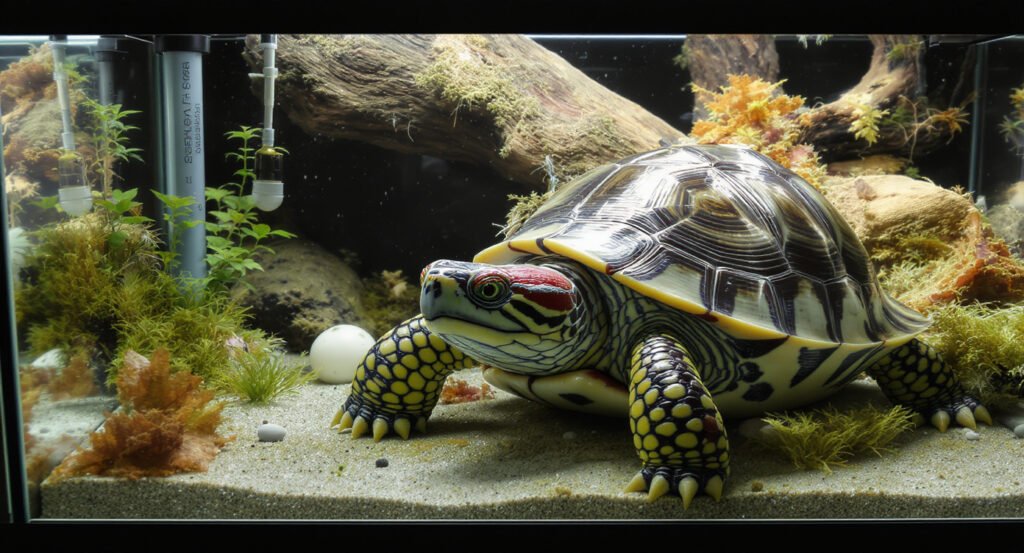
So you’ve decided to welcome a red-eared slider into your home. Great choice! These charismatic aquatic turtles are among the most popular pet reptiles worldwide, known for their distinctive red markings and engaging personalities. But before your new shelled friend arrives, you’ll need to create the perfect habitat.
Setting up a proper red-eared slider enclosure isn’t complicated, but it does require some planning and investment. This guide walks you through everything you need to know to create a thriving environment for your turtle.
Tank Size: Bigger Is Always Better
Here’s the most important rule: red-eared sliders need space—lots of it. While hatchlings can start in smaller setups, adult sliders require a minimum of 75 gallons, with 100+ gallons being ideal.
Why so large? Red-eared sliders are active swimmers that can reach 8-12 inches in shell length. They spend most of their time in water, so they need room to swim, dive, and explore. A cramped tank leads to stress, health problems, and poor water quality.
Worried About Your Reptile's Health?
Upload a photo and get instant AI health analysis. Catch problems before they become expensive vet bills.
Get Free Health Check →Tank size guidelines:
- Hatchlings (2-3 inches): 20-40 gallons
- Juveniles (4-6 inches): 55-75 gallons
- Adults (7+ inches): 75-125+ gallons
Pro tip: Start with a larger tank if possible. Your turtle will grow faster than you expect, and upgrading tanks later is expensive and disruptive.
Water Quality and Filtration: The Foundation of Turtle Health
Red-eared sliders are messy eaters and produce significant waste. Without proper filtration, ammonia and nitrites quickly build up, causing shell rot, respiratory infections, and other serious health issues.
Your filtration system should be rated for 2-3 times your tank’s volume. For a 75-gallon turtle tank, use a filter designed for 150-225 gallons of fish-only aquariums. Canister filters work best for large turtle setups, though hang-on-back filters can work for smaller tanks.
Never Miss Early Warning Signs
AI photo analysis catches subtle health issues humans miss 80% of the time. Early detection = healthier reptile + lower vet bills.
Start Free Trial →Popular filter options include:
- Fluval FX series canister filters
- Penn-Plax Cascade canister filters
- Zoo Med Turtle Clean filters
Even with excellent filtration, you’ll need to perform partial water changes weekly (25-30% of total volume) and monitor water parameters regularly with a test kit.
The Perfect Basking Area
Red-eared sliders are semi-aquatic, meaning they need both water and a dry basking area. Basking serves multiple purposes: it helps them thermoregulate, dry their shells (preventing bacterial growth), and absorb essential UVB rays.
Your basking platform should:
Join thousands of successful reptile owners
Try ReptileCoach Free →- Be easily accessible with a gentle ramp or steps
- Be completely dry when your turtle is on it
- Provide enough space for your turtle to turn around comfortably
- Be sturdy enough to support your turtle’s full weight
Options include floating docks, above-tank basking platforms, stacked rocks (secured with aquarium-safe silicone), or DIY platforms made from egg crate and river stones.
Lighting: UVB and Heat Are Non-Negotiable
Proper lighting is absolutely critical for red-eared sliders. You’ll need two types of lights over the basking area:
UVB Lighting
UVB rays enable your turtle to synthesize vitamin D3, which is essential for calcium absorption and shell health. Without adequate UVB, sliders develop metabolic bone disease, a painful and potentially fatal condition.
Use a reptile-specific UVB bulb (not a regular fluorescent light) rated at 5.0-10.0 UVB. The bulb should span 50-75% of the tank length and be positioned 10-12 inches above the basking spot. Replace UVB bulbs every 6-12 months, as their output diminishes over time even when they still produce visible light.
"This app saved my bearded dragon's life. The AI caught early MBD in photos I thought looked completely normal. Worth every penny!"
— Sarah K., ReptileCoach User
Get Your Free 7-Day Trial →Heat Lighting
A basking heat lamp creates the warm temperature gradient your turtle needs. The basking spot should reach 85-90°F, while ambient air temperature can be cooler (75-80°F).
Use a standard incandescent bulb, halogen bulb, or ceramic heat emitter. Wattage depends on your room temperature and distance from the basking spot—start with 75-100 watts and adjust based on temperature readings with a digital thermometer.
Water Temperature: Keeping Things Comfortable
Red-eared sliders thrive in water temperatures between 75-80°F. Most homes aren’t naturally this warm, so you’ll need an aquarium heater.
Choose a submersible heater rated for your tank size (typically 3-5 watts per gallon). For larger setups, consider two smaller heaters instead of one large one—this provides redundancy and more even heating.
Worried About Your Reptile's Health?
Upload a photo and get instant AI health analysis. Catch problems before they become expensive vet bills.
Get Free Health Check →Important: Place heaters where your turtle can’t directly contact them or knock them against the glass. Use a heater guard if necessary. Monitor water temperature daily with an aquarium thermometer.
Substrate: To Use or Not to Use?
Substrate is one of the most debated topics in turtle keeping. Here’s the honest truth: for beginners, a bare-bottom tank is usually best.
Benefits of bare-bottom tanks:
- Easier to clean and maintain
- No risk of impaction if your turtle ingests substrate
- Better water quality visibility
- Lower cost
If you prefer a more natural look, safe substrate options include large river rocks (too big to swallow) or sand designed specifically for aquariums. Avoid gravel, which poses a serious impaction risk.
Never Miss Early Warning Signs
AI photo analysis catches subtle health issues humans miss 80% of the time. Early detection = healthier reptile + lower vet bills.
Start Free Trial →Essential Equipment Checklist
Let’s recap everything you need for a complete red-eared slider setup:
- 75+ gallon aquarium or turtle tub
- Canister filter rated for 2-3x tank volume
- UVB bulb (5.0-10.0) with fixture
- Basking heat lamp with dome fixture
- Submersible aquarium heater
- Basking platform or dock
- Digital thermometers (one for water, one for basking area)
- Water testing kit (for ammonia, nitrite, nitrate, pH)
- Dechlorinator/water conditioner
- Timer for lights (12-hour day/night cycle)
Budget for $400-700 for a complete beginner setup, though costs vary based on tank size and equipment quality.
Ready to Create the Perfect Home for Your Slider?
Setting up a red-eared slider habitat is an investment in your turtle’s long-term health and happiness. These amazing reptiles can live 20-40 years with proper care, so taking time to create the right environment from the start pays off.
Looking for personalized guidance tailored to your specific situation? Check out our custom care plan tool to get expert recommendations based on your turtle’s age, size, and your available space.
Join thousands of successful reptile owners
Try ReptileCoach Free →Remember: red-eared sliders are active, intelligent animals that deserve spacious, clean environments. With the right setup, you’ll enjoy watching your turtle’s personality shine as it swims, basks, and explores its home for decades to come.
Have questions about your red-eared slider setup? The reptile community is full of helpful keepers who’ve been where you are. Don’t hesitate to reach out and learn from experienced turtle enthusiasts as you embark on this rewarding journey.
Ready to Give Your Reptile the Best Care?
Stop guessing and start knowing. Get personalized AI-powered care guidance, photo health analysis, and 24/7 expert advice for YOUR specific reptile.
Get Personalized Care Guidance
AI-powered photo analysis and daily care tracking for YOUR reptile
Try Free for 7 Days →