Proper UVB lighting is absolutely critical for chameleon health, yet it remains one of the most misunderstood aspects of chameleon care. Without adequate UVB exposure, chameleons cannot synthesize vitamin D3, leading to metabolic bone disease and other serious health issues. This comprehensive guide will help you choose, install, and maintain the right UVB lighting system for your chameleon.
Why Chameleons Need UVB Lighting
In their natural habitats, chameleons bask in direct sunlight to absorb UVB rays. These invisible wavelengths between 290-320 nanometers trigger vitamin D3 production in their skin, which is essential for calcium metabolism. Indoor chameleons rely entirely on artificial UVB lighting to replicate this natural process.
Without proper UVB exposure, chameleons develop metabolic bone disease (MBD), characterized by weak bones, tremors, difficulty climbing, and deformities. Even with calcium supplements in their diet, chameleons cannot properly absorb and utilize calcium without adequate UVB.
Choosing the Right UVB Bulb for Your Chameleon
Not all UVB bulbs are created equal. For chameleons, linear fluorescent tube bulbs are strongly recommended over compact fluorescent coil bulbs, which have been associated with eye problems and provide inconsistent UVB output.
Worried About Your Reptile's Health?
Upload a photo and get instant AI health analysis. Catch problems before they become expensive vet bills.
Get Free Health Check →Recommended UVB Strength
- 5.0 UVB bulbs: Suitable for smaller enclosures or species that prefer lower UVB levels
- 10.0 UVB bulbs: Ideal for screen-topped enclosures where UVB is filtered, recommended for most chameleon species
- 12% UVB bulbs: Best for larger enclosures or montane species like Jackson’s chameleons
The most popular chameleon species—veiled chameleons, panther chameleons, and Jackson’s chameleons—typically thrive with a 5.0 or 10.0 linear fluorescent UVB bulb positioned correctly within their enclosure.
Proper UVB Lighting Setup and Placement
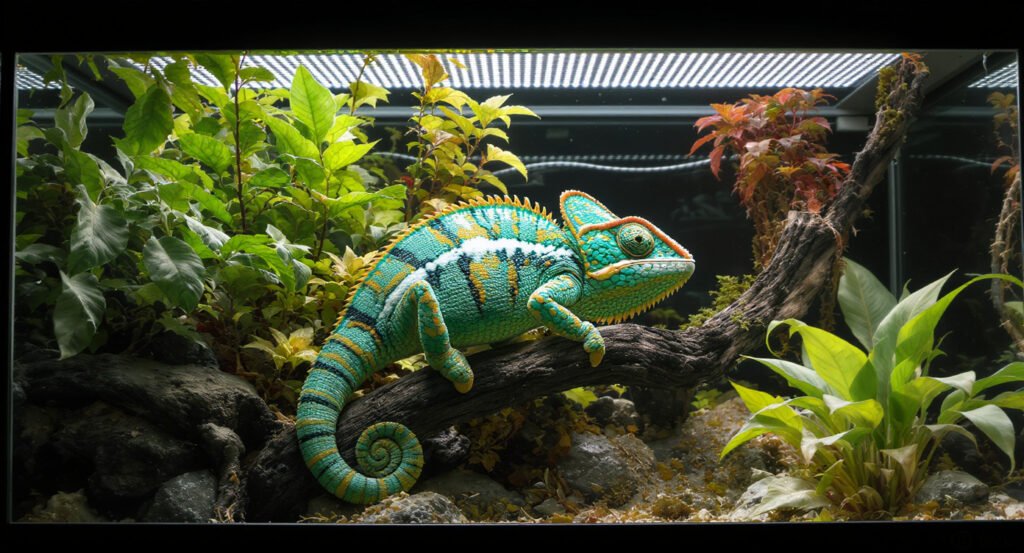
Correct placement of your chameleon UVB lighting is just as important as choosing the right bulb. The positioning determines how much UVB actually reaches your chameleon.
Installation Guidelines
- Mount the UVB bulb inside the enclosure whenever possible, as screen mesh can block up to 50% of UVB output
- Position the bulb 8-12 inches from your chameleon’s highest basking branch
- Use a reflective fixture to direct UVB downward into the enclosure
- Ensure the bulb spans at least half the enclosure length to create a UVB gradient
- Never place glass or plastic between the bulb and your chameleon, as these materials block UVB
Create a basking area where your chameleon can get closer to the UVB source, but also provide shaded areas where they can retreat. This gradient allows your chameleon to self-regulate their UVB exposure naturally.
UVB Bulb Maintenance and Replacement Schedule
Many reptile owners make the critical mistake of waiting until a UVB bulb burns out to replace it. However, UVB output degrades significantly over time, even while the bulb still produces visible light.
Never Miss Early Warning Signs
AI photo analysis catches subtle health issues humans miss 80% of the time. Early detection = healthier reptile + lower vet bills.
Start Free Trial →Replace your chameleon’s UVB bulb every 6-12 months depending on the manufacturer’s recommendations. Most quality bulbs like Reptisun and Arcadia maintain effective UVB output for 12 months, while budget brands may need replacement every 6 months. Mark your calendar when you install a new bulb so you don’t forget this essential maintenance task.
Consider investing in a UVB meter to measure actual UVB output in your enclosure. This tool removes guesswork and helps you determine optimal basking distances and replacement timing.
Common Chameleon UVB Lighting Mistakes
Even experienced keepers sometimes make these preventable errors that compromise their chameleon’s health:
- Using compact coil bulbs: These bulbs have inconsistent UVB distribution and have been linked to eye issues in chameleons
- Placing bulbs outside screen tops: Mesh can block 30-50% of UVB, reducing effectiveness significantly
- Positioning bulbs too far away: UVB intensity decreases rapidly with distance; measure carefully
- Forgetting to replace bulbs: Invisible UVB output fails long before visible light does
- Relying solely on supplements: While vitamin D3 supplements help, they cannot fully replace natural UVB synthesis
- Using bulbs not designed for reptiles: Plant grow lights and aquarium bulbs do not provide appropriate UVB wavelengths
Combining UVB with Heat Lighting
Your chameleon needs both UVB lighting and a separate heat source. UVB bulbs do not produce significant heat, so you’ll need a basking bulb to create the temperature gradient chameleons require.
Join thousands of successful reptile owners
Try ReptileCoach Free →Position your heat bulb and UVB bulb side by side so your chameleon receives both when basking. The basking spot should reach 85-90°F for veiled and panther chameleons, or 80-85°F for Jackson’s chameleons, while UVB exposure occurs simultaneously.
Monitoring Your Chameleon’s Health
Even with proper UVB lighting, monitor your chameleon regularly for signs of vitamin D3 deficiency or MBD. Watch for lethargy, loss of appetite, soft jaw, curved spine, or difficulty climbing. These symptoms require immediate veterinary attention.
Regular health monitoring helps you catch problems early. Keep notes on your chameleon’s behavior, feeding response, and physical condition.
Ready to track your reptile’s diet and care schedule? Try the ReptileCoach app free — your all-in-one reptile care companion.
"This app saved my bearded dragon's life. The AI caught early MBD in photos I thought looked completely normal. Worth every penny!"
— Sarah K., ReptileCoach User
Get Your Free 7-Day Trial →Conclusion
Proper chameleon UVB lighting is non-negotiable for keeping these remarkable reptiles healthy in captivity. By choosing the right linear fluorescent bulb, positioning it correctly within the enclosure, and maintaining a regular replacement schedule, you provide your chameleon with the essential UVB exposure they need to thrive. Combined with proper nutrition, hydration, and temperature management, quality UVB lighting forms the foundation of successful chameleon care.
Ready to Give Your Reptile the Best Care?
Stop guessing and start knowing. Get personalized AI-powered care guidance, photo health analysis, and 24/7 expert advice for YOUR specific reptile.
Get Personalized Care Guidance
AI-powered photo analysis and daily care tracking for YOUR reptile
Try Free for 7 Days →