
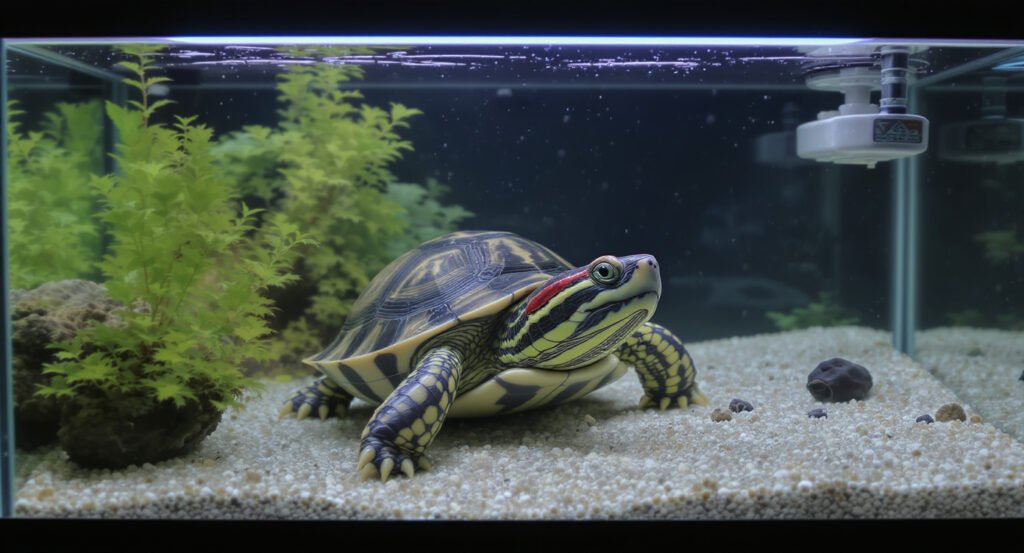
Setting up a proper habitat for your red-eared slider is one of the most important steps in ensuring your turtle lives a long, healthy life. These popular aquatic turtles require specific conditions to thrive, and getting the setup right from the start will save you time, money, and potential health issues down the road.
Tank Size Requirements for Red-Eared Sliders
One of the most common mistakes new turtle owners make is underestimating how large red-eared sliders grow. While hatchlings are only about 1-2 inches long, adult females can reach 10-12 inches, and males typically grow to 8-10 inches.
The general rule is to provide 10 gallons of water per inch of shell length. For an adult red-eared slider, this means:
- A minimum 75-gallon tank for a single adult turtle
- 100-120 gallons for optimal comfort and swimming space
- Larger tanks (150+ gallons) if housing multiple turtles
Investing in a larger tank from the beginning prevents the need for costly upgrades as your turtle grows. Glass aquariums are the most popular choice, though large plastic stock tanks or custom-built enclosures also work well.
Worried About Your Reptile's Health?
Upload a photo and get instant AI health analysis. Catch problems before they become expensive vet bills.
Get Free Health Check →Water Filtration System
Red-eared sliders are notoriously messy eaters and produce significant waste. A robust filtration system is absolutely essential for maintaining water quality and preventing bacterial infections and shell rot.
Filter Requirements
Choose a canister filter rated for at least 2-3 times your tank’s water volume. For a 75-gallon tank, select a filter rated for 150-225 gallons. Canister filters provide superior mechanical, chemical, and biological filtration compared to hang-on-back filters.
Popular filter options include:
- Fluval FX series for large setups
- Penn-Plax Cascade canister filters for mid-sized tanks
- Zoo Med Turtle Clean filters designed specifically for turtle habitats
Perform partial water changes (25-30%) weekly even with a quality filter, and clean filter media monthly to maintain optimal performance.
Never Miss Early Warning Signs
AI photo analysis catches subtle health issues humans miss 80% of the time. Early detection = healthier reptile + lower vet bills.
Start Free Trial →Basking Area Setup
Red-eared sliders are semi-aquatic and must have a dry basking area where they can completely exit the water. This basking platform should occupy about 25-30% of the tank’s surface area.
Basking Platform Options
- Commercial turtle docks that attach to tank walls with suction cups
- DIY platforms made from egg crate lighting diffuser and rocks
- Large smooth river rocks stacked securely above water line
- Cork bark pieces positioned to create a ramp and flat basking surface
The basking area should have a gentle slope for easy access and be completely stable. Ensure the platform can support your turtle’s full adult weight without tipping.
Lighting Requirements
Proper lighting is critical for red-eared slider health. These turtles need two types of light bulbs positioned over the basking area.
UVB Lighting
A UVB bulb (10.0 or 5.0 strength) is essential for calcium metabolism and preventing metabolic bone disease. Position the bulb 10-12 inches above the basking platform and replace it every 6-12 months, as UVB output decreases over time even when the bulb still produces visible light.
Join thousands of successful reptile owners
Try ReptileCoach Free →Heat Lamp
A separate heat lamp or ceramic heat emitter maintains the basking temperature at 85-90°F (29-32°C). Use an adjustable fixture to fine-tune the temperature, and always use a thermometer to verify basking temps rather than estimating.
Maintain a photoperiod of 10-12 hours of light per day, using a timer to ensure consistency.
Water Temperature and Heating
The water temperature should remain between 75-78°F (24-26°C) year-round. Most homes require an aquarium heater to maintain this range, especially during winter months.
Select a submersible heater rated for your tank size (typically 3-5 watts per gallon). Protect the heater with a heater guard to prevent your turtle from breaking it or burning themselves on the glass surface.
"This app saved my bearded dragon's life. The AI caught early MBD in photos I thought looked completely normal. Worth every penny!"
— Sarah K., ReptileCoach User
Get Your Free 7-Day Trial →Substrate Considerations
Many experienced turtle keepers recommend a bare-bottom tank for red-eared sliders. This setup makes cleaning easier and eliminates the risk of substrate ingestion, which can cause impaction.
If you prefer a more natural look, use large river rocks (too large to swallow) or a sand substrate. Avoid small gravel, which poses a serious impaction risk if ingested during feeding.
Water Depth
Red-eared sliders are strong swimmers and appreciate deep water. The water should be at least 1.5-2 times the length of your turtle’s shell, allowing them to fully extend their neck to reach the surface while standing on the bottom.
For adult turtles, this typically means 12-18 inches of water depth, providing ample swimming space and exercise opportunities.
Worried About Your Reptile's Health?
Upload a photo and get instant AI health analysis. Catch problems before they become expensive vet bills.
Get Free Health Check →Common Setup Mistakes to Avoid
New turtle owners frequently make these errors:
- Starting too small: Buying a 20-gallon tank for a baby slider that will quickly outgrow it
- Inadequate filtration: Using filters designed for fish-only aquariums
- No UVB lighting: Relying only on heat lamps without UVB exposure
- Improper water temperature: Neglecting to use a heater or thermometer
- Unstable basking area: Using platforms that tip or don’t support full adult weight
- Mixing incompatible species: Housing red-eared sliders with fish or other turtle species
Ongoing Maintenance Schedule
Once your setup is complete, maintain it with this regular schedule:
- Daily: Check temperatures, remove uneaten food, observe turtle behavior
- Weekly: 25-30% water change, test water parameters
- Monthly: Clean filter media, scrub algae from glass and decorations
- Every 6-12 months: Replace UVB bulbs, inspect equipment for wear
Track Your Red-Eared Slider’s Care with Technology
Managing feeding schedules, water changes, temperature logs, and health observations can be overwhelming, especially for first-time turtle owners. Track your reptile’s care schedule with ReptileCoach App, designed specifically for reptile keepers who want to ensure their pets receive consistent, optimal care. Set reminders for water changes, feeding times, and equipment maintenance, and log health observations to identify patterns over time. Join thousands of reptile enthusiasts who trust ReptileCoach to help them provide the best possible care for their scaly companions.
Ready to Give Your Reptile the Best Care?
Stop guessing and start knowing. Get personalized AI-powered care guidance, photo health analysis, and 24/7 expert advice for YOUR specific reptile.
Get Personalized Care Guidance
AI-powered photo analysis and daily care tracking for YOUR reptile
Try Free for 7 Days →