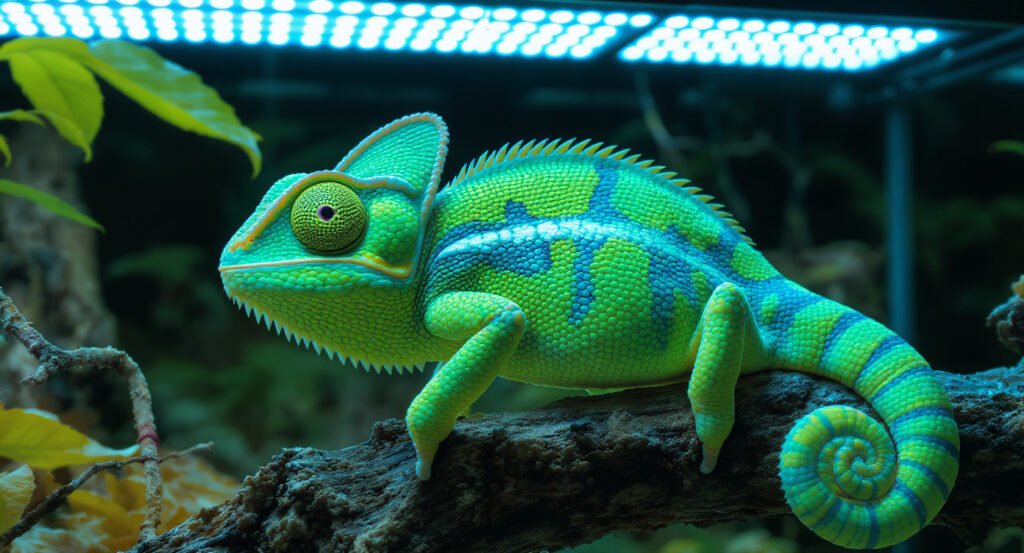
Providing proper UVB lighting is one of the most critical aspects of chameleon care. Without adequate UVB exposure, chameleons cannot synthesize vitamin D3, leading to metabolic bone disease and other serious health issues. This comprehensive guide covers everything you need to know about chameleon UVB lighting to keep your pet healthy and thriving.
Why Chameleons Need UVB Lighting
In their natural habitat, chameleons bask in unfiltered sunlight, which contains UVB rays essential for calcium metabolism. UVB light allows chameleons to produce vitamin D3, which enables them to absorb dietary calcium properly. Without this process, chameleons develop metabolic bone disease (MBD), a painful and potentially fatal condition characterized by weakened bones, tremors, and deformities.
Indoor chameleon enclosures must replicate this natural sunlight exposure through artificial UVB lighting. Standard household bulbs and glass windows do not provide adequate UVB radiation, making dedicated reptile UVB bulbs absolutely essential.
Understanding UVB Bulb Types
Several types of UVB bulbs are available for chameleon keepers, each with distinct characteristics:
Worried About Your Reptile's Health?
Upload a photo and get instant AI health analysis. Catch problems before they become expensive vet bills.
Get Free Health Check →Linear Fluorescent Tubes
Linear fluorescent tubes are the gold standard for chameleon UVB lighting. These long, tube-shaped bulbs provide consistent UVB coverage across a large area, allowing your chameleon to move freely while maintaining exposure. The most recommended options are:
- T5 High Output (HO) bulbs: These produce stronger UVB output and are ideal for taller enclosures. The 5.0 or 6% UVB bulbs work well for most chameleon species, while the 10.0 or 12% options suit larger enclosures or species requiring higher UVB levels.
- T8 bulbs: These older-style tubes produce less UVB than T5 HO bulbs and must be placed closer to basking areas. They’re adequate but generally considered inferior to T5 options.
Compact Fluorescent Bulbs
Compact fluorescent or coil bulbs are smaller, screw-in style UVB bulbs. While convenient, they have significant limitations for chameleon care. Their UVB output covers a much smaller area, creating inconsistent exposure zones. Many experienced keepers avoid these bulbs due to reports of eye problems in reptiles, though modern versions have improved.
Mercury Vapor Bulbs
Mercury vapor bulbs combine heat and UVB in a single high-output bulb. These powerful bulbs work well for very large enclosures but can be challenging to regulate properly. They produce significant heat, which may create temperature management issues in standard chameleon setups.
Choosing the Right UVB Strength
UVB bulbs are rated by their UVB output percentage. For chameleons, the appropriate strength depends on species and enclosure setup:
Never Miss Early Warning Signs
AI photo analysis catches subtle health issues humans miss 80% of the time. Early detection = healthier reptile + lower vet bills.
Start Free Trial →- 5.0-6% UVB bulbs: Suitable for most chameleon species including veiled chameleons, panther chameleons, and Jackson’s chameleons in standard screen enclosures.
- 10.0-12% UVB bulbs: Appropriate for larger enclosures, glass terrariums that filter some UVB, or species naturally found in more exposed habitats.
Screen mesh can block up to 50% of UVB radiation, so bulbs should ideally be mounted inside the enclosure or directly on top of screen lids rather than above additional barriers.
Proper UVB Bulb Placement and Distance
Correct placement of your chameleon UVB lighting is crucial for effectiveness and safety. Follow these guidelines:
Distance from basking spot: Position the UVB bulb so your chameleon’s basking area is 8-12 inches below the light for T5 HO bulbs. For T8 bulbs, reduce this distance to 6-8 inches. Too far reduces UVB exposure; too close risks overexposure.
Coverage area: Linear tubes should span at least half to two-thirds of the enclosure length, providing multiple zones of UVB exposure as your chameleon moves throughout the day.
Join thousands of successful reptile owners
Try ReptileCoach Free →Fixture positioning: Mount fixtures with reflectors to direct UVB downward into the enclosure. Reflective fixtures can increase UVB output by up to 100% compared to bare bulbs.
Avoid obstructions: Ensure branches, plants, and other decorations don’t completely block UVB rays from reaching basking areas, though partial shade creates beneficial gradients.
UVB Lighting Schedule
Chameleons require a consistent photoperiod that mimics natural day-night cycles:
- Duration: Provide 10-12 hours of UVB lighting daily. Most keepers use 12 hours during summer months and 10 hours during winter to simulate seasonal changes.
- Consistency: Use a timer to maintain the same lighting schedule daily. Chameleons are highly sensitive to routine, and irregular lighting can cause stress.
- No nighttime UVB: Turn off all lighting at night. Chameleons need complete darkness and cooler temperatures during nighttime hours for proper rest.
Need personalized care advice? Try our AI Reptile Coach for instant expert guidance.
"This app saved my bearded dragon's life. The AI caught early MBD in photos I thought looked completely normal. Worth every penny!"
— Sarah K., ReptileCoach User
Get Your Free 7-Day Trial →UVB Bulb Replacement Schedule
UVB bulbs lose effectiveness long before they visibly burn out. Even if a bulb still produces visible light, its UVB output degrades over time:
- T5 and T8 fluorescent tubes: Replace every 10-12 months regardless of whether they still light up.
- Compact fluorescent bulbs: Replace every 6 months due to faster UVB degradation.
- Mercury vapor bulbs: Replace annually, though some high-quality models maintain UVB output longer.
Mark your calendar when installing new bulbs to ensure timely replacement. Some keepers use a UV meter to measure actual UVB output and replace bulbs when readings drop below recommended levels.
Common UVB Lighting Mistakes
Avoid these frequent errors that compromise chameleon health:
Using household bulbs: Regular LED, incandescent, or fluorescent bulbs don’t produce UVB. Only bulbs specifically designed for reptiles provide necessary UVB radiation.
Worried About Your Reptile's Health?
Upload a photo and get instant AI health analysis. Catch problems before they become expensive vet bills.
Get Free Health Check →Placing bulbs outside glass: Glass blocks UVB rays. Never position UVB bulbs outside glass terrarium walls or above glass barriers.
Over-relying on compact bulbs: While better than nothing, compact bulbs don’t provide sufficient coverage for most chameleon enclosures. Linear tubes are strongly preferred.
Forgetting replacement schedules: Using expired bulbs is nearly as harmful as having no UVB at all, since chameleons won’t receive adequate UVB despite the bulb appearing functional.
Incorrect distance: Placing bulbs too far reduces UVB to ineffective levels, while placing them too close can cause eye damage or thermal burns.
Never Miss Early Warning Signs
AI photo analysis catches subtle health issues humans miss 80% of the time. Early detection = healthier reptile + lower vet bills.
Start Free Trial →Recommended UVB Product Setup
For a standard adult chameleon enclosure (24″ x 24″ x 48″), consider this setup:
- One 24″ T5 HO fixture with a 5.0 or 6% UVB linear bulb
- Reflective fixture to maximize UVB output
- Digital timer for consistent 12-hour photoperiod
- Separate basking bulb for heat (UVB bulbs produce minimal warmth)
Quality brands include Arcadia, Zoo Med, and ReptiSun. While initial costs are higher for proper UVB equipment, the investment prevents expensive veterinary bills and ensures your chameleon’s long-term health.
Final Thoughts
Proper chameleon UVB lighting is non-negotiable for responsible reptile keeping. By choosing appropriate bulb types, positioning them correctly, maintaining consistent schedules, and replacing bulbs on time, you create the foundation for a healthy, thriving chameleon. Combined with proper diet, hydration, and temperature regulation, adequate UVB exposure enables your chameleon to live a long, active life free from metabolic bone disease and other preventable conditions.
Ready to Give Your Reptile the Best Care?
Stop guessing and start knowing. Get personalized AI-powered care guidance, photo health analysis, and 24/7 expert advice for YOUR specific reptile.
Get Personalized Care Guidance
AI-powered photo analysis and daily care tracking for YOUR reptile
Try Free for 7 Days →